How does a river lock work?
How does a 35-tonne boat go up or down a river? The answer comes down to one word: the lock.
The principle: a lift for boats
A river like the Marne flows gently downhill towards the sea. To make it navigable all year round, it is divided into levels, called reaches, held back by weirs. A lock lets boats pass from one reach to the next: it is a basin closed by two gates, the lock chamber, in which the water level is raised or lowered.
- The boat enters the chamberThe gates open on the side where the boat is, and it moors along the lock walls.
- The gates are closedThe chamber becomes a large watertight basin.
- The sluices are openedTo go up, water is let in from the upstream reach; to go down, the chamber is emptied into the downstream reach. No pumps: the natural slope of the water does all the work.
- The levels even outThe boat gently rises or falls with the water, then the gates on the other side open: it sets off on the new reach.
An ancient invention
The first pound locks appeared in China around the year 984. In Europe, they were perfected during the Renaissance: Leonardo da Vinci is credited with "mitre" gates, which close at an angle pointing upstream. The water pressure presses them against each other and keeps them watertight. This is still the system used on most locks today.
The Marne, a canalised river
- The Marne is only navigable from Épernay: upstream, the river itself is not, and canals take over.
- From Épernay to where it meets the Seine, the Marne is navigable and canalised over 183 km, with 18 locks.
- The canalisation work was carried out in the 19th century, with canals cutting across the river's great meanders.
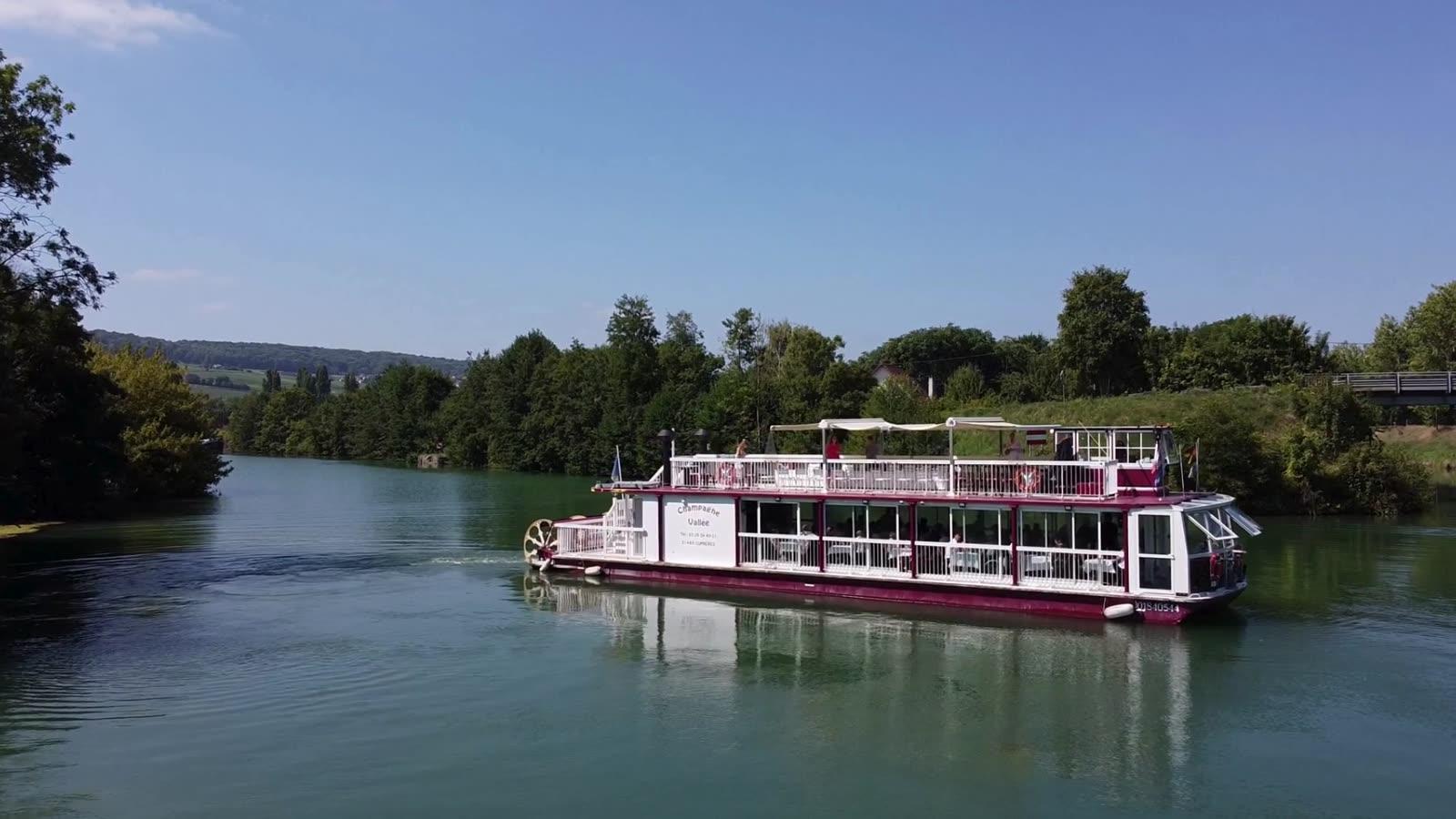
- On this upstream section, the locks are about 45 m long: the Champagne Vallée, at 27 m, fits in easily.
- The locks are managed by Voies Navigables de France (VNF); boats announce themselves to the lock keepers by radio.
Cumières lock, no. 1
Cumières lock is number 1: it is the very first lock on the canalised Marne heading towards Paris. Our landing stage is therefore at the very start of the navigable Marne, a unique place to set off on a cruise.
The Dizy lock… too narrow for us!
Just upstream, at Dizy, begins the Marne lateral canal, which runs to Vitry-le-François: 67 km and 15 locks, opened to navigation in 1846. Its locks are built to the Freycinet gauge, designed for boats no wider than 5.05 m. But the Champagne Vallée is 5.40 m wide: it simply cannot fit into the Dizy lock!
Sources: Voies Navigables de France; Wikipedia, "Marne (river)"; actunautique.com.
Read also
Experience Champagne from the water
Board in Cumières, at the foot of Hautvillers, for a commented cruise, a lunch or a dinner on the Marne.