Home · The curious corner · Boatman's glossary
On the waterThe boatman's glossary
The words of river people, to talk about navigation like our captain.
- Upstream, downstream
- Upstream (amont) is the direction the river comes from, downstream (aval) the direction it flows. In French, boatmen say "monter" going upstream and "avaler" going downstream.
- Mooring line (amarre)
- A rope that holds the boat at the quay. "Casting off" means untying them to set off.
- Get under way (appareiller)
- To leave the quay and set off sailing.
- Port, starboard (bâbord, tribord)
- The left side (port) and right side (starboard) of the boat, when facing forward.
- Lock wall (bajoyer)
- The side wall of a lock, along which the boat moors.
- Boatman (batelier, marinier)
- A professional of inland navigation, on rivers and canals. Also called "river people" (gens de l'eau).
- Reach (bief)
- A stretch of river or canal between two locks, with a constant water level.
- Bollard (bitte)
- A heavy metal post fixed on the quay or the boat, around which mooring lines are wound.
- Towpath (chemin de halage)
- A path running along the river. In the past, horses, and even men, pulled the boats along with ropes: this was towing. Today it is a favourite with walkers and cyclists.
- Fender (défense)
- A cushion (once made of rope, now often rubber) hung along the hull to protect it against the quay.
- Lock keeper (éclusier)
- The person in charge of operating the lock.
- Low water, flood (étiage, crue)
- Low water is the river's lowest level, in summer; a flood is its rise after heavy rain. In both cases, navigation may be suspended.
- Bow, stern (étrave, poupe)
- The bow is the front of the boat, which cuts through the water; the stern is the back.
- Freycinet gauge
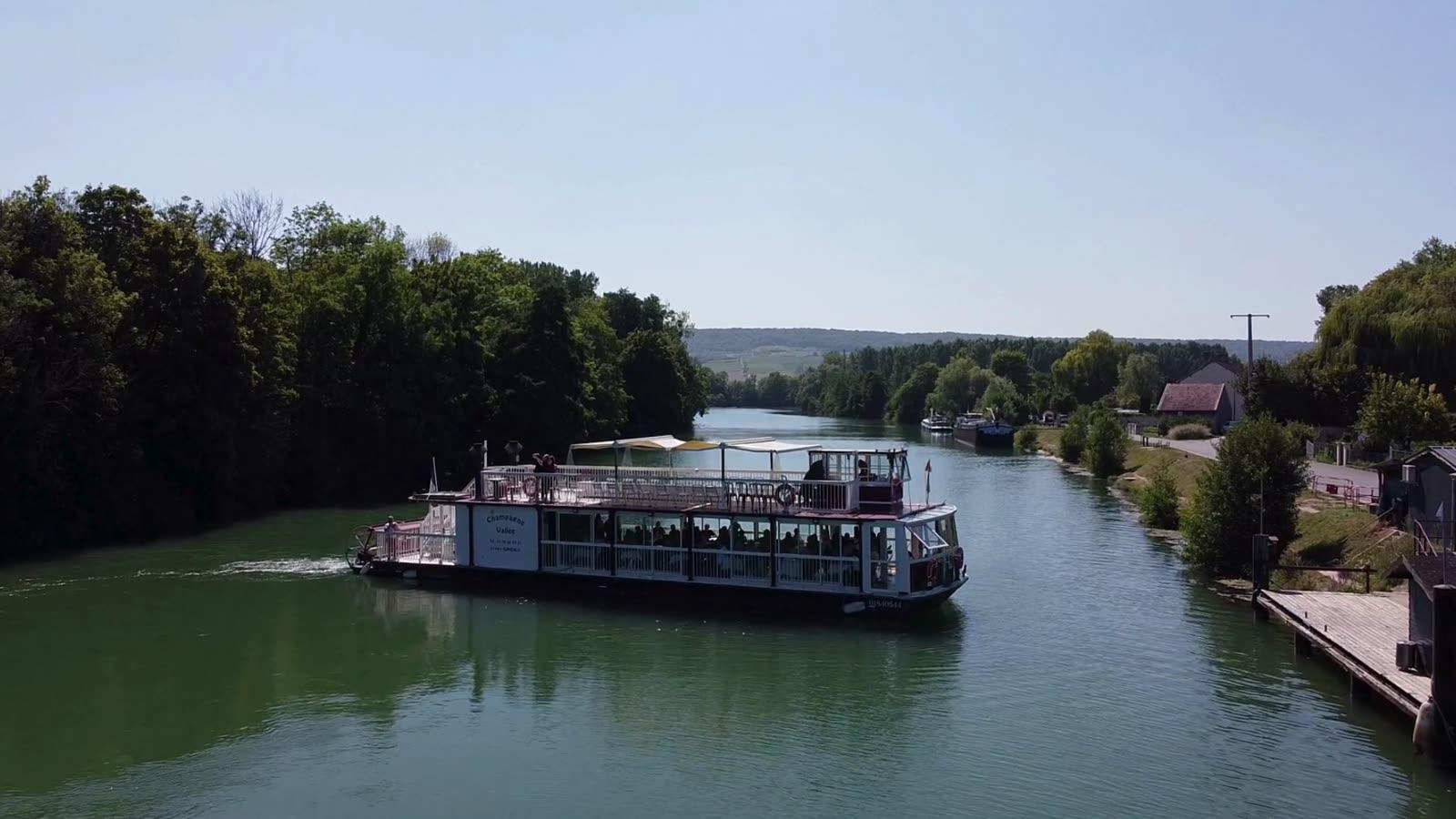
- The standard dimensions of French locks, set in 1879 by minister Charles de Freycinet: boats up to 38.50 m long and 5.05 m wide. At 5.40 m, the Champagne Vallée is too wide for these locks.
- Boat hook (gaffe)
- A long pole with a hook, used to catch a mooring line or push the boat off.
- Barge (péniche)
- A freight boat built to the Freycinet gauge. Boatmen lived on board with their families.
- Kilometre point (PK)
- A distance marker along a waterway, shown on signs on the bank.
- Bow thruster
- A small propeller at the front that pushes the boat sideways to make manoeuvring easier. The Champagne Vallée has one.
- Right bank, left bank
- Defined when looking downstream, in the direction of the current.
- Lock chamber (sas)
- The basin of the lock, closed by two gates, in which the water level rises or falls.
- Wheelhouse (timonerie)
- The steering position, from which the captain pilots the boat.
- Draught, air draught
- Draught is the depth of the submerged part of the boat (about 40 cm for the Champagne Vallée); air draught is its height above the water, which matters when passing under bridges.
- VNF
- Voies Navigables de France, the public body that manages most of France's navigable rivers and canals.
A boatman's daughterOur captain, Ingrid, grew up aboard a barge on the canals of Europe: she has known these words since childhood. Meet Ingrid.
Read also
Experience Champagne from the water
Board in Cumières, at the foot of Hautvillers, for a commented cruise, a lunch or a dinner on the Marne.